
Free Vedic Astrology Tool
Ashtakoot Matching Calculator
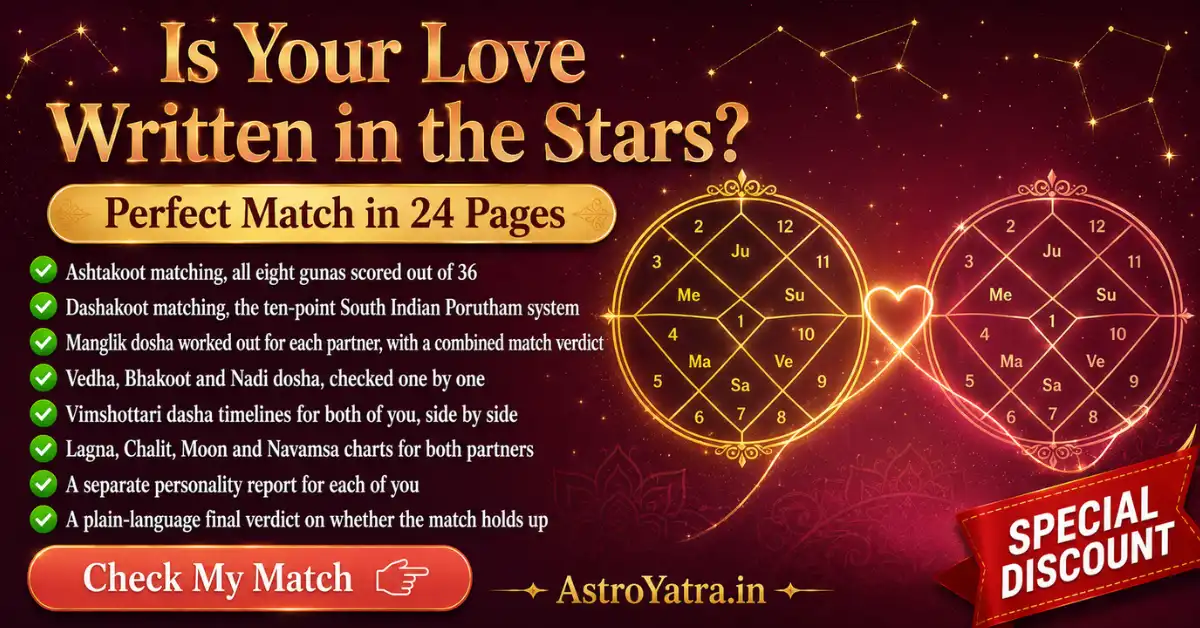
Check marriage compatibility between two birth charts with the 8-Koota Ashtakoot system from Parasara Hora Shastra, and get a score out of 36 gunas.
Enter Birth Details
Want the full picture? Get a detailed Vedic astrology report
What is Ashtakoot Matching?
Ashtakoot Matching - also known as the 36-Guna system or Kundali Milan - is the most widely practiced method of horoscope compatibility assessment in North Indian Vedic astrology. Rooted in the ancient text Parasara Hora Shastra authored by the sage Maharishi Parasara, this system has guided Hindu marriages for over two millennia.
The word "Ashtakoot" breaks down into Ashta (eight) and Koot (group or aspect). The system evaluates eight distinct cosmic compatibility factors - kootas - each associated with a specific dimension of married life. Together they produce a total score out of 36 gunas (qualities or points).
Crucially, all eight kootas are derived solely from the Moon's position - specifically the Moon's nakshatra (lunar mansion) and rashi (zodiac sign) in each person's birth chart. The Moon represents mind, emotions, instincts, and karmic memory, making it the most relevant planet for assessing emotional and domestic compatibility in a lifelong partnership.
The 8 Kootas in Detail
1. Varna (1 point)
Varna represents spiritual evolution and ego compatibility. The four varnas - Brahmin, Kshatriya, Vaishya, Shudra - reflect the spiritual hierarchy. The boy's varna should be equal to or higher than the girl's for harmonious spiritual alignment. It is the simplest koota but sets the foundation for mutual respect.
2. Vashya (2 points)
Vashya measures the degree of natural influence, attraction, and control one partner has over the other. The five vashya groups - Manava (human), Chatushpada (quadruped), Jalchar (aquatic), Keeta (insect), and Vanchar (wild) - determine who naturally dominates the relationship and whether that dynamic is harmonious.
3. Tara (3 points)
Tara (also called Dina) assesses health, longevity, and overall well-being within the marriage. It is calculated by counting the nakshatras from each person's birth star to the other's. Stars that fall in positions 1 (Janma), 2 (Sampat), 4 (Kshema), 6 (Sadhaka), and 8 (Mitra) are auspicious, contributing to physical health and vitality.
4. Yoni (4 points)
Yoni denotes sexual compatibility, biological temperament, and physical harmony. Each nakshatra is classified under one of 14 animal symbols (horse, elephant, goat, etc.). Matching yonis score full points; hostile yoni pairs (e.g., horse-buffalo, elephant-lion) score zero and indicate physical incompatibility and conflict.
5. Graha Maitri (5 points)
Graha Maitri evaluates mental and intellectual compatibility through the friendship between the Moon sign lords. If both Moon-sign rulers are mutual friends, the couple shares deep mental harmony. Enmity between lords indicates misaligned thinking patterns, disagreements about goals, and lack of mutual understanding.
6. Gana (6 points)
Gana reflects temperament, nature, and behavioral disposition. The three ganas - Deva (divine), Manushya (human), and Rakshasa (demonic) - describe the inherent nature. Deva-Deva or Manushya-Manushya combinations are ideal. A Rakshasa gana person paired with a Deva gana person can create significant temperamental friction.
7. Bhakoot (7 points)
Bhakoot (or Rashi) examines material prosperity, emotional bonding, and family well-being. It is determined by the relative position of Moon signs. A 6/8 relationship (sixth and eighth signs from each other) or 12/2 pattern creates Bhakoot Dosha, potentially leading to financial difficulty and emotional distance.
8. Nadi (8 points)
Nadi carries the highest weight in the system, reflecting genetic compatibility, health of offspring, and ancestral karma. The three nadis - Vata (air), Pitta (fire), and Kapha (water) - correspond to Ayurvedic body constitutions. Same-nadi couples are said to have Nadi Dosha, which classical texts associate with health complications and difficulties with progeny.
Understanding Your Score
Rare and exceptional compatibility. Strong karmic connection.
High compatibility. Most successful marriages fall here.
Good foundation. Minor adjustments needed.
Acceptable with conscious effort and mutual respect.
Significant incompatibilities. Expert consultation advised.
A score below 18 is generally considered inadvisable by classical texts, but no match is perfect or imperfect in isolation. Many harmonious marriages exist with scores in the 18–24 range when both partners are emotionally mature and committed. Conversely, even a high score does not guarantee happiness without effort and alignment of values. Ashtakoot matching is a tool for awareness, not a verdict on destiny.
Nadi Dosha and Bhakoot Dosha
Nadi Dosha
Nadi Dosha occurs when both individuals belong to the same nadi (Vata, Pitta, or Kapha). Classical texts like Muhurta Chintamani consider this the most serious dosha in the system, as it carries the maximum 8 points and relates to genetic compatibility and health of future children.
Exceptions (Nadi Dosha cancellation) include cases where both partners share the same nakshatra but different padas (quarters), or when they share the same rashi but different nakshatras. In practice, many couples with Nadi Dosha lead healthy lives, especially with appropriate Vedic remedies.
Bhakoot Dosha
Bhakoot Dosha arises from a 6/8 (Shad-Ashtak) or 12/2 (Dwadashashtam) relationship between the Moon signs. The 6th and 8th house relationship is associated with obstacles, health issues, and financial strain. The 12/2 pattern relates to emotional and material imbalance.
Bhakoot Dosha is considered less severe than Nadi Dosha and is frequently cancelled when both Moon sign lords are mutual friends (high Graha Maitri score) or when both partners share the same rashi but different nakshatras. Experienced astrologers always evaluate these cancellations before advising.
Frequently Asked Questions
Is Ashtakoot matching sufficient for deciding a marriage?+
Ashtakoot matching is one important tool, but classical astrology recommends a comprehensive chart analysis alongside it. Factors like Mangal Dosha, Dasha periods, the 7th house and its lord, Venus and Jupiter positions, and overall chart strength should all be evaluated. Most seasoned astrologers treat Ashtakoot as a preliminary filter, not the final verdict.
What is the minimum score recommended for marriage?+
Classical texts recommend a minimum score of 18 out of 36. Scores between 18–24 are considered acceptable, 25–32 very good, and 33 and above excellent. However, the presence of major doshas like Nadi Dosha even at a high overall score warrants careful consideration and often specific remedies.
Can Nadi Dosha be cancelled?+
Yes, several classical cancellation rules exist. Nadi Dosha is cancelled if both partners have the same rashi but different nakshatras, the same nakshatra but different rashis, or the same nakshatra and rashi but different padas. Additionally, if the lords of both Moon signs are the same planet, the dosha's effects are mitigated.
Why is the Moon used instead of the Sun sign?+
In Vedic astrology, the Moon represents the mind, emotions, subconscious patterns, and our instinctual nature - the very qualities that determine how we relate to a life partner on a daily basis. The Sun represents ego and outer identity, while Venus rules romance. The Moon's nakshatra captures our innermost emotional blueprint, making it the ideal indicator for marital harmony.
Does the same nakshatra for both partners cause problems?+
Same nakshatra can create Nadi Dosha if both also share the same nadi. However, if the nadi differs (possible in some nakshatras based on pada), it scores full Nadi points. Same nakshatra with different padas often produces cancellation of both Nadi and Bhakoot Doshas. The interplay between nakshatra and pada is nuanced and worth examining with a qualified astrologer.
Is Ashtakoot matching followed in South India?+
South Indian astrology traditionally uses Dashakoot (10-factor) or Porutham matching instead, which evaluates different factors including Rajju and Vedha - two aspects absent from the North Indian system. Rajju in particular is considered critical in South Indian matching as it relates to the longevity of the husband. Both systems ultimately use Moon nakshatra as the basis.
Can love marriages benefit from Ashtakoot analysis?+
Absolutely. Even in love marriages, Ashtakoot analysis provides valuable insight into the areas of potential harmony and friction in the relationship. Understanding your compatibility profile helps couples prepare for challenges in specific domains - whether financial (Bhakoot), health (Nadi), or temperamental (Gana) - and address them proactively through communication and awareness.
How accurate is online Ashtakoot calculation?+
The accuracy depends entirely on the precision of the Moon position calculation. Our tool uses the Swiss Ephemeris standard - the gold standard in astronomical computation - to calculate exact planetary positions at the moment of birth, accounting for timezone (IST to UTC conversion) and geographic coordinates. This ensures the nakshatra and rashi assignments are as accurate as any professional software.